

Trump v. Rice's Whale
Will the "God Squad" snuff out a species?

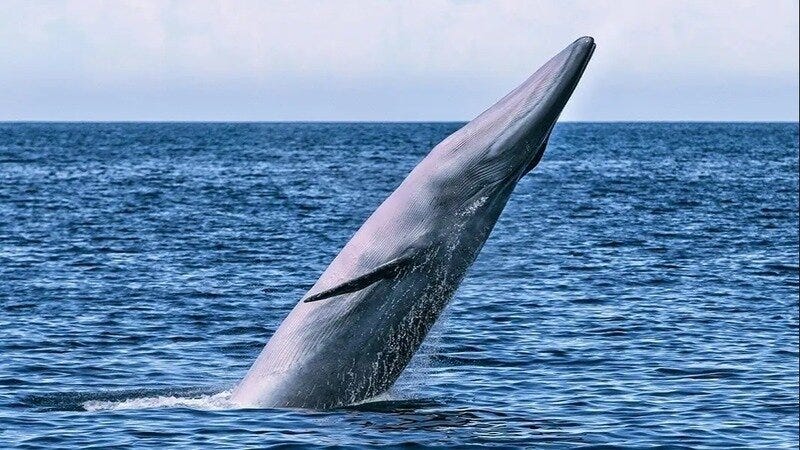
Rice’s Whale, Gulf of Mexico
I was writing in a New Orleans coffee house last spring, when another customer noticed the ocean stickers on my laptop and offered me a new one in support of a regional cause: the Rice’s whale, a species that had only recently been identified and is listed as endangered under the Endangered Species Act (ESA). That’s because only about 50 of these creatures exist. And they all live full-time in the Gulf of Mexico.
I’ve seen many species of whales, but never this one. I’m told they have very distinct vocalization patterns and a unique diving pattern. Unlike many whales that feed near the surface, Rice's whales make deep dives toward the seafloor during the day to feed on fish and spend their nights sleeping within 50 feet of the surface.
The Trump administration apparently wants them gone.
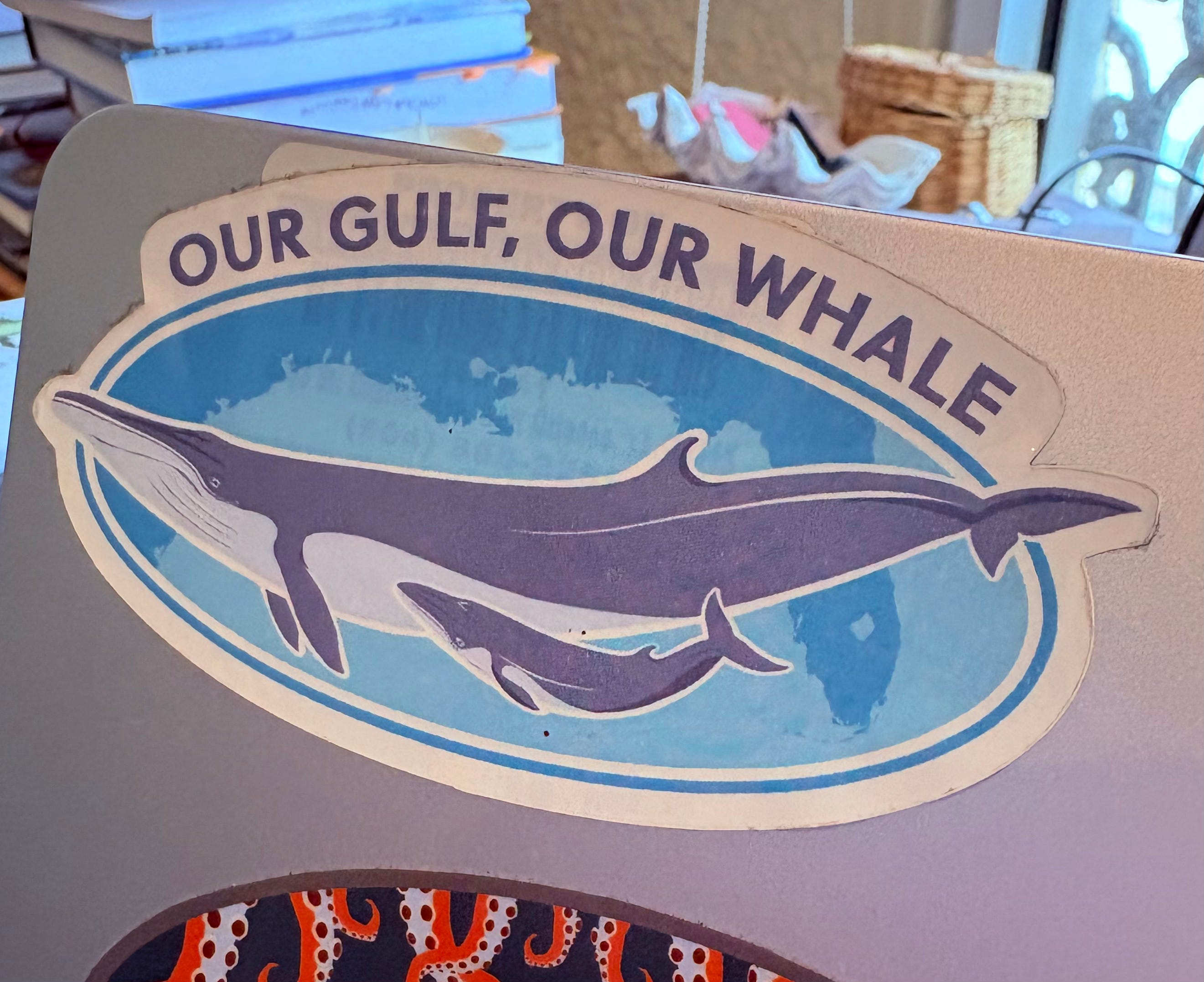
My laptop, our whale
Last Friday, the Secretary of the Interior Doug Burgum announced he will convene a rare meeting of the Endangered Species Committee—known as the “God Squad”—to consider stripping away ESA protections across the entire “Gulf of America.” That is, to condemn the Rice’s whale and other vulnerable species to extinction. The reason, we are told, is concern for “oil and gas exploration, development, and production.”
Some things to say up front: To anyone familiar with the law of natural resources, the announcement is so outrageous and ridiculous as to amount to trolling, which is probably what it is, in part. That said, such ridiculousness now requires serious organizations and serious lawyers to mount multi-year campaigns to fight these efforts, lest the wondrous Gulf of Mexico be downgraded to an enormous 24-hour gas station.
OK, I promised not to steer myself into a dark place.
There are things we can do to get the word out and stop this. But before I get there, let me fill you in on the Gulf’s endangered species, the conflict with Big Oil, and the human-made limits of the God Squad.
Uneasy Neighbors in the Gulf
Rice’s whales share Gulf waters with at least eighteen other threatened or endangered species, including the sperm whale (the star of Moby Dick) and five species of sea turtles.
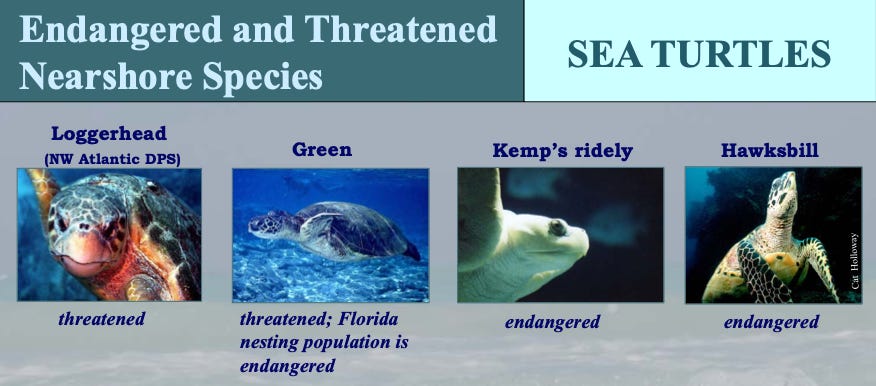
Protected sea turtle species in the Gulf of Mexico. Source: NOAA
They live uneasily with another Gulf leviathan: Big Oil and Gas. Offshore drilling was invented in Louisiana and its expansion in the Gulf over the last hundred-plus years has resulted in one of the highest concentrations of offshore oil infrastructure in the world, with more than 3,500 active wells and 14,000 inactive wells in these waters.
Here’s how the paths of whales and rigs cross. The dots represent oil rig platforms. The blue ribbon is Rice’s whale habitat.
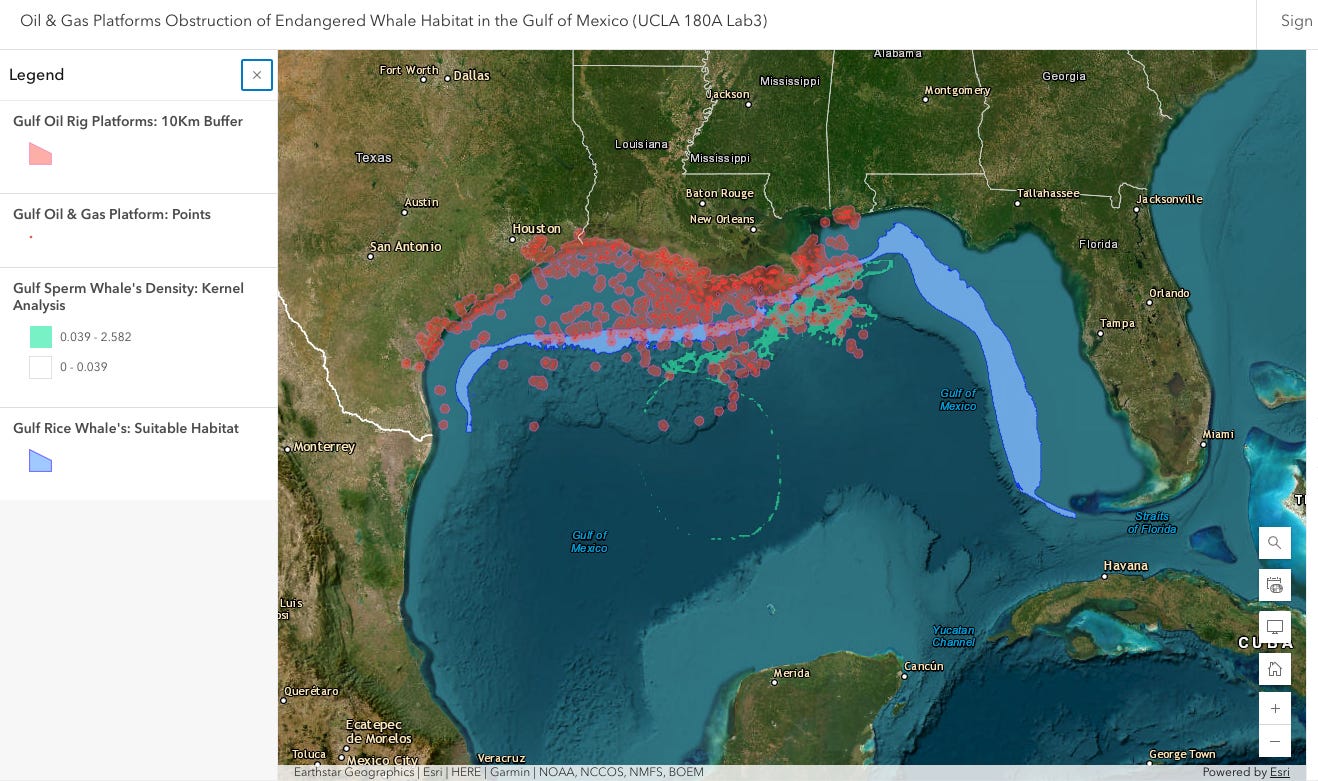
Source: UCLA ArcGIS online (2025)
The oil industry poses several risks to Rice’s whales, most notably vessel strikes (remember, they sleep near the surface), incessant noise (making it hard to communicate), and oil spills, including the lingering effects of the BP oil spill. Did I mention that ocean heating, caused by carbon emissions, is redistributing the whale’s food supply and inhibiting its reproduction?
The God Squad
I mentioned that the God Squad could condemn the Rice’s whale and other species to extinction.
Is government-forced extinction really a thing? The answer is yes.
Section 7 of the ESA requires federal agencies to ensure that their actions are not likely to “jeopardize the continued existence” of an endangered species. When the government concludes an action would jeopardize an endangered species, the action cannot proceed.
Congress created the God Squad forty years ago as a safety valve of last resort to prevent this strict standard from upending rare projects of critical importance. The gravity of the decision is reflected in the membership of the committee, which is made up of the secretaries of the Interior, Agriculture, and the Army; administrators from NOAA and EPA; and the head of the Council of Economic Advisers. (Representatives of affected states are also included.) Under the law, the Endangered Species Committee meets to decide on an ESA exemption only after a public process, including a trial-like hearing in which evidence is formally presented.
In the forty years since Congress created the committee, it has met only a handful of times and has voted only twice to exempt a project from ESA protections—once for a dam affecting whooping cranes and a second time for timber sales affecting the northern spotted owl. Thankfully both birds are still hanging on. (The dam project contained significant mitigation measures. The proposed timber sales were ultimately withdrawn.)
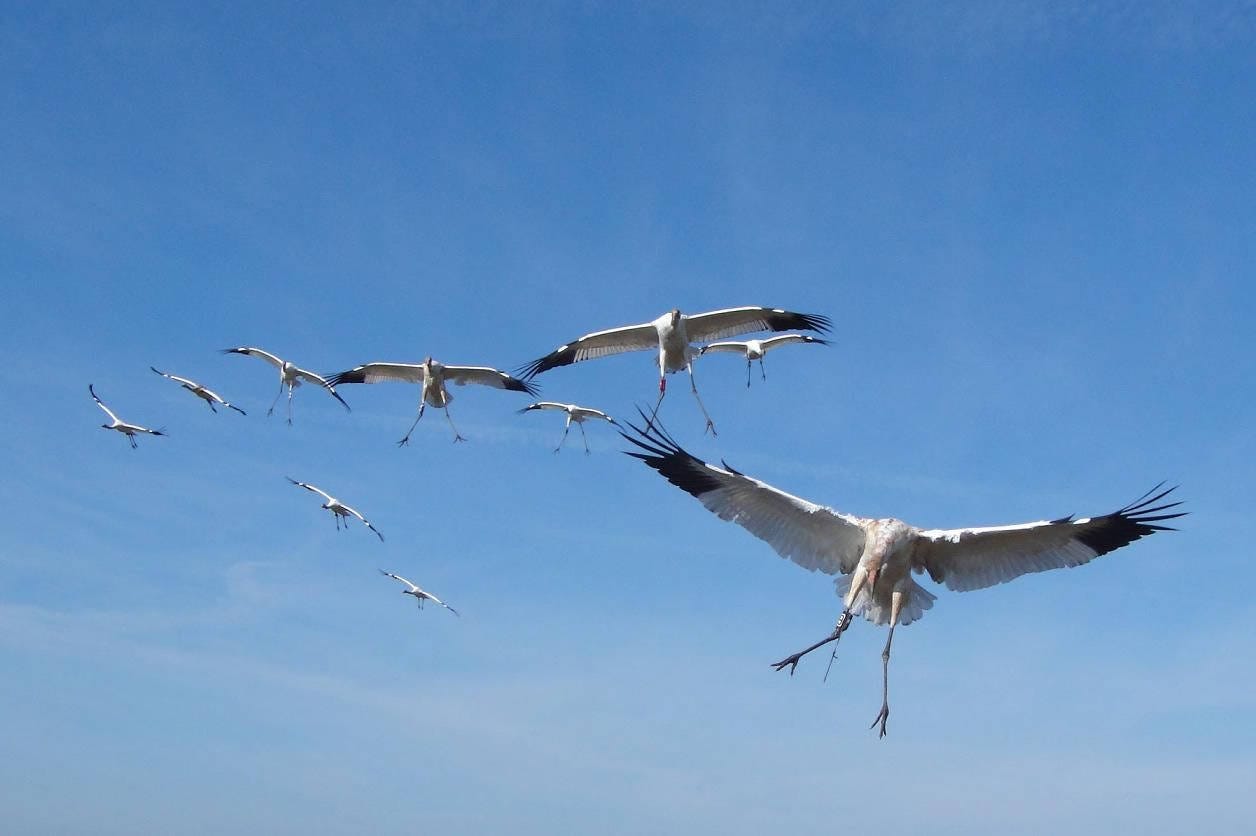
Whooping cranes. Photo: U.S. Fish and Wildlife Service
Legal Limitations
Though called the God Squad, it’s important to understand that this committee is still bound by human-made law. And its actions and decisions can be challenged in court.
I see at least three ways that Trump’s God Squad could get itself in legal trouble.
First, the administration appears to be using the exception process in an overly broad way. Rather than singling out a particular project (like a dam or a timber sale), it instead refers to an entire category of activity—offshore oil and gas development across a vast region. On top of that, Trump wants the God Squad on speed dial. He has ordered the committee to meet “not less than quarterly.” He seems to envision a regular docket of extinction inquiries. Whatever Congress was thinking when it put the Secretary of Interior in charge of God’s creation, it did not mean that.
As law professor Patrick Parenteau told E&E News, the idea that Secretary Burgum can “whistle up the committee whenever he [feels] like it is complete and utter nonsense.”
Second, the ESA’s multi-step procedural requirements on this matter are clear. The committee can only convene in response to an application made within 90 days of a “jeopardy” finding. Before rendering a decision, it must hold a public hearing, including witness testimony, that is presided over by an administrative law judge. None of these requirements has been met. While there have been “jeopardy” findings involving oil projects and the Rice’s whale, the most recent was issued nearly a year ago. There has been no announcement of a public meeting, no administrative law judge discussed or appointed. For these reasons, the Center for Biological Diversity today filed a lawsuit seeking to prevent the committee from convening at all.
Third, to grant an exemption, the committee must find there is no “reasonable and prudent alternative” to the proposed action. The problem for the oil industry is that earlier “jeopardy” findings involving the Rice’s whale (including the most recent one) have found that industry could indeed operate in a way that would not jeopardize the species—namely by doing things like limiting vessel speed, conducting better monitoring, and limiting nighttime activity. No one is saying oil companies cannot drill for oil, only that they must do it responsibly.
What You Can Do
This is all very frustrating and sad, I know. But the answer to despair is action. Here are three things you can do.
You can learn more about the Gulf of Mexico, its ecological importance, and the laws and policies that protect it. Hey, if you’ve read all the way through, you’ve already done that one.
You can keep an eye on the Trump administration’s God Squad by watching that meeting (assuming it goes forward), which convenes on Tuesday, March 31, 2026 at 9:30 a.m. Eastern Time. Yes, it’s theater. Yes, there is a vast difference between a real public hearing and a YouTube stream. But watching will allow you to understand what we’re up against and to bear witness.
The meeting will be open to the public through live streaming here.
The meeting will also be recorded and accessible at the Department’s events page for 60 days after the meeting.
Finally, if the federal government tries to override endangered species protections, the fight will move to the courts—and to public pressure.
Consider offering your money or your time to Healthy Gulf, a regional environmental nonprofit that is a party in major lawsuits challenging offshore lease sales harming Rice’s whale. Or consider national organizations working in this space, like the Center for Biological Diversity, Earth Justice, or the NRDC.
The Gulf of Mexico is no gas station. It is an undulating universe of all five kingdoms of planetary life, from the world’s biggest whale (the great blue) to the tiniest one-cell alga. We belong there too, as do our future generations. You see, the Gulf belongs to all of us. Not to a jury-rigged God Squad. And certainly not to an oil company.
SOUNDINGS
Well done Rob!
I am already a big supporter of both Healthy Gulf and Biological Diversity, but i am glad you gave them both shout outs. I will do the same!